
Hybrid RAG: How to Improve Information Retrieval in AI Agents
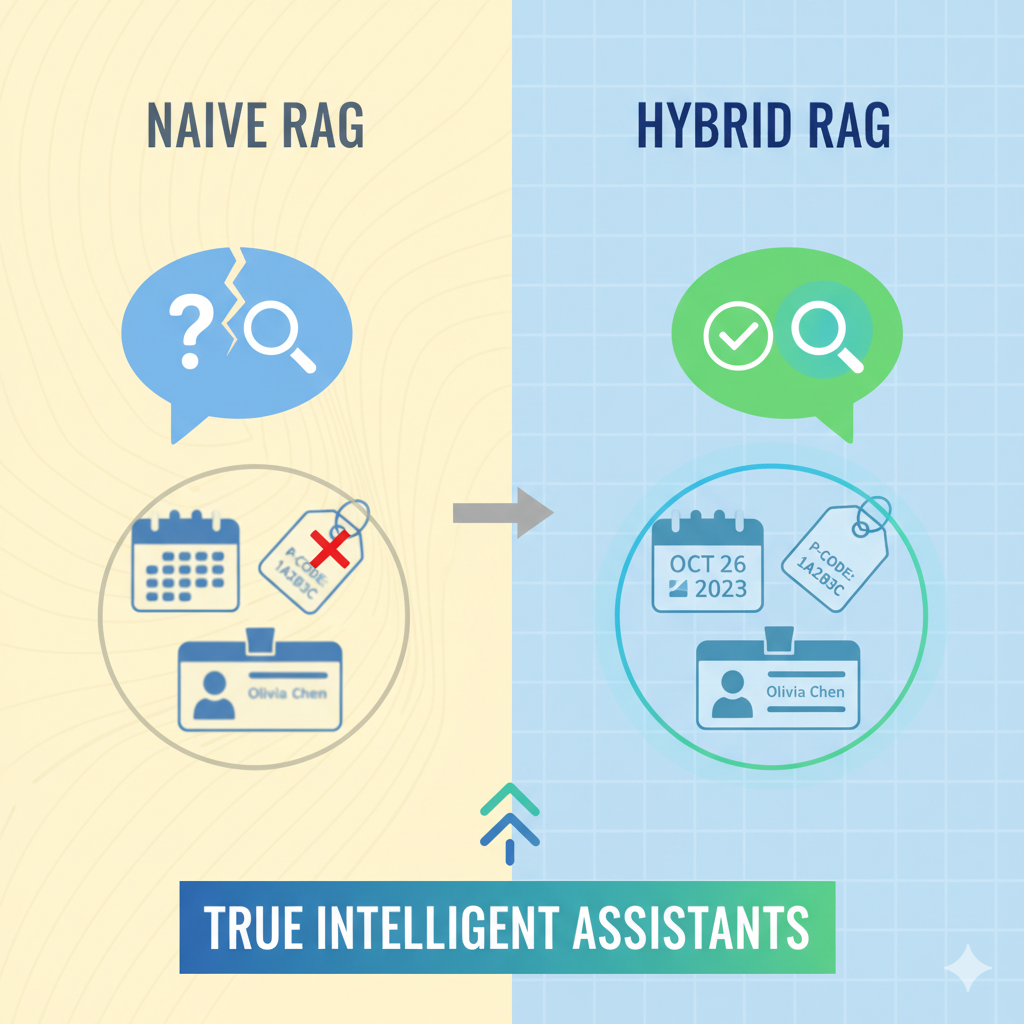
Have you ever asked a chatbot a question and received a vague or wrong answer? That often happens because traditional RAG (Naive RAG) relies only on semantic search, great for understanding context, but not so precise when we need exact information like product codes, dates, or specific names.
Hybrid RAG fixes this by combining semantic and lexical search, bringing the best of both worlds: contextual understanding and literal accuracy. The result is much more reliable AI agents, capable of answering both open-ended and highly specific questions with speed and confidence.
In short: Hybrid RAG turns chatbots into true intelligent assistants, ready to handle any kind of question in the real world.
Introduction
Have you ever built a chatbot or AI agent using RAG and noticed that the answers weren’t quite what you expected? Often, the AI seems to struggle to find the right piece of information among the sea of data it has access to. That’s because traditional RAG, often referred to as Naive RAG, usually relies only on semantic search. This method is great at understanding meaning and context, but it can fail when what you need is an exact match, think product IDs, item colors, or a specific date.
For example: imagine a customer asking a restaurant chatbot which dishes contain broccoli. Depending on how it’s set up, the bot might return dishes with ingredients that are "similar" to broccoli, but not necessarily broccoli itself. That’s where Hybrid RAG comes into play. It combines the strengths of both approaches: semantic search (to grasp intent) and lexical search (literal keyword matching).
What is Traditional RAG?

Retrieval-Augmented Generation (RAG) is a technique that enhances a Large Language Model (LLM) by supplementing it with information retrieved from external sources, instead of relying only on its pre-trained data.
For instance: GPT-3.5 was trained only up until a certain year. If you ask about more recent events — or data from PDFs, private documents, or company databases — the model alone wouldn’t know the answer. That’s where RAG acts as a bridge, pulling the relevant data and allowing the AI to generate answers that are both contextual and factually correct.
In other words, RAG helps "ground" the AI’s responses so they are less about guessing and more about using real information.
If you want to dive deeper into how Naive RAG works, here are two resources worth checking out:
Search Types: Semantic vs. Lexical
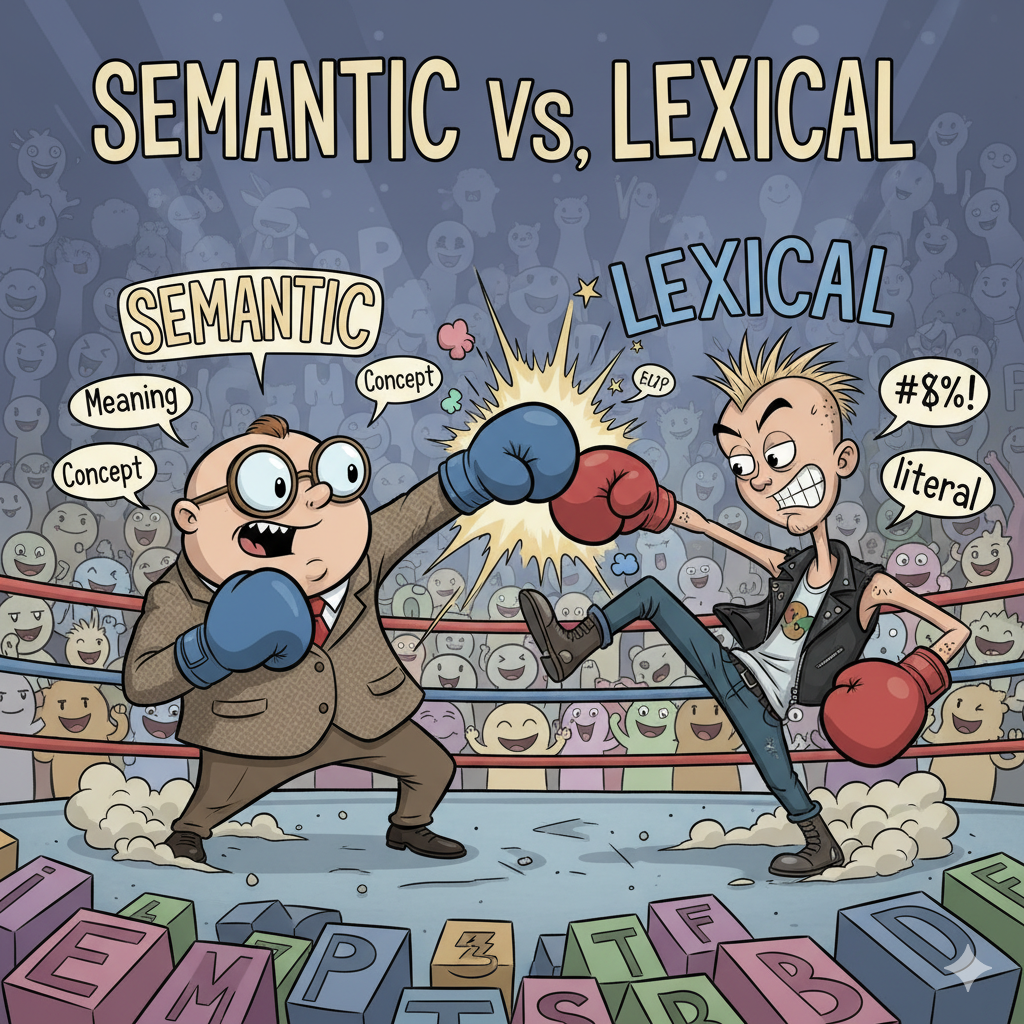
Traditional RAG relies heavily on semantic search, which measures similarity in meaning. This works very well for broad, context-heavy queries but struggles when precision is key.
On the other hand, lexical search (keyword-based) is all about exact matches. Its advantages include speed, precision, and reliability for literal terms like IDs, technical errors, or product names.
Example:
- If you search Google for "error E-404", you’ll get back pages mentioning exactly that error.
- But if you type "my computer won’t start", you’re unlikely to find a guide titled "Fixing Power Failures in Desktops". Only semantic search would bridge that gap.
Hybrid RAG
Hybrid RAG blends semantic and lexical search into one powerful approach. This way, the system can understand context while also being precise about literal matches. This makes agents more robust and flexible to handle different types of queries.
Comparison of Retrieval Methods
🔹 Keyword Search (BM25)
- Principle: Matches literal keywords.
- Strengths: Very fast; highly precise for exact terms, acronyms, product codes.
- Weaknesses: Doesn’t understand context, synonyms, or variations in language.
- Best suited for: Queries like “Find documents with ISO-27001.”
🔹 Vector Search (Semantic/Dense Retrieval)
- Principle: Finds semantic similarities between text embeddings (vectors).
- Strengths: Great for understanding context, synonyms, and broad concepts.
- Weaknesses: Can miss exact terms; requires heavy computation.
- Best suited for: Queries like “Tell me about information security standards.”
🔹 Hybrid Search
- Principle: Combines keyword and semantic methods.
- Strengths: Balances precision (lexical) and context (semantic); robust across diverse queries.
- Weaknesses: More complex to implement; may have slightly higher latency.
- Best suited for: Both exact and conceptual queries, without compromise.
Conclusion
Hybrid RAG emerges as a natural evolution of traditional RAG. While Naive RAG helps anchor answers with external context, it often falls short in situations where users need literal accuracy. Combining semantic and lexical search fixes this gap.
In practice, this makes chatbots, virtual assistants, and AI agents much more reliable. They can understand the intent and capture precise details, reducing vague or misleading answers. For companies, this translates into more effective customer interactions, smarter technical support, and faster, data-backed decision-making.
In today’s world where data grows more complex by the second, Hybrid RAG ensures AI doesn’t just find the needle in the haystack — it finds the right needle. That means faster, more consistent, and more relevant answers — exactly what we expect from true artificial intelligence.
Further Reading
If you’d like to explore more about RAG and Hybrid RAG, here are some recommended resources:
- Hybrid Search: Combining Dense and Sparse Retrieval – a detailed explanation of why and how to use hybrid search methods.
- FAISS: A Library for Efficient Similarity Search – open-source library from Meta for building semantic/vector search systems.
- BM25 Explained – the classic lexical search algorithm used in many retrieval pipelines.
Member discussion