
How to engineer a prompt?

The Core Framework
A great starting point is Jeff Su's video on structured prompting:
He introduces six building blocks, ranked by importance:
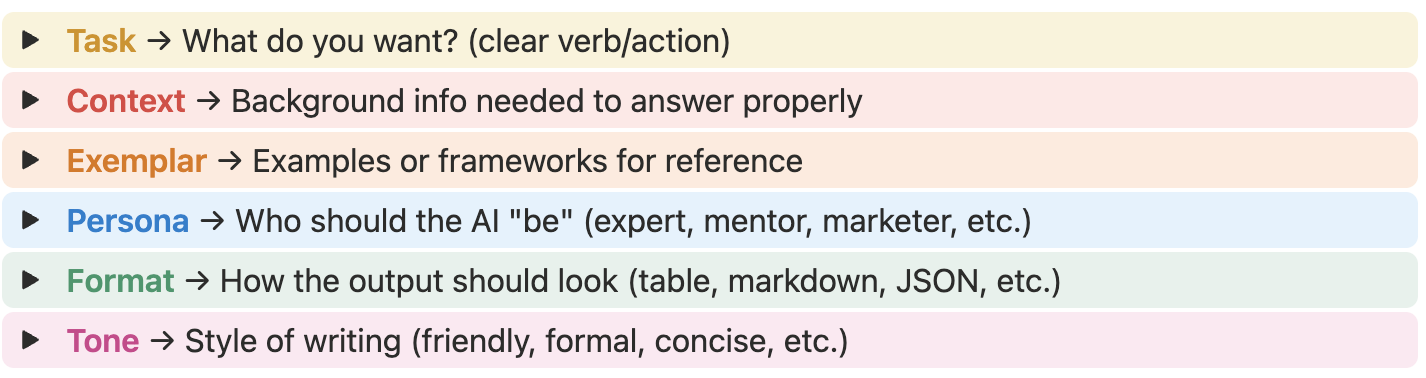
- Task → What do you want? (clear verb/action)
- Example: “Summarize,” “Generate,” “Compare,” “Explain.”
- Be specific: instead of “Write about marketing” say “Write a 500-word article summarizing current B2B SaaS marketing trends.”
- Context → Background info needed to answer properly
- Why: Without context, AI fills in gaps with assumptions.
- Include audience, timeframe, and scope. Example: “For university students in 2025, explain how…”
- Exemplar → Examples or frameworks for reference
- Why: Models learn from patterns, so examples anchor the style/structure.
- Use: “Follow this structure → intro, 3 key insights, summary.”
- Persona → Who should the AI "be" (expert, mentor, marketer, etc.)
- Why: Framing changes voice, depth, and perspective.
- Example: “You are a career coach with 10+ years of experience.”
- Format → How the output should look (table, markdown, JSON, etc.)
- Why: Saves time post-editing.
- Example: “Return as Markdown with bullet points,” “Give JSON with keys
title,summary,tags.”
- Tone → Style of writing (friendly, formal, concise, etc.)
- Why: Makes outputs match audience expectations.
- Example: “Friendly and encouraging,” “Formal and academic,” “Direct and concise.”
Prompt Engineering Example with Framework
Here's how to use the framework in practice with color-coding for clarity:
Bad Prompt
"Write me a blog post about climate change."
Good Prompt (with framework applied)
"[TASK] Write a 600-word blog post
[CONTEXT] for general readers explaining the impacts of Arctic ice melt in 2025
[EXEMPLAR] using the structure: intro → 3 key sections → conclusion [PERSONA] You are an experienced environmental journalist
[FORMAT] Present facts in Markdown with bullet points under each section [TONE] Write in a clear, empathetic, slightly urgent style."
Member discussion